
Story - SES - LUREC Immersive Learning

Ray Dybzinski, associate professor in the School of Environmental Sustainability, shows students how to use equipment that measures soil and plant respiration, among other ecological skills.
Ecology campus provides experiential learning—and career readiness
Courses and certifications immerse students in environmental studies
At 💖苹果ID | 15年以上老号 | Icloud后缀 | 激活iCloud设置和下载APP | 美国/香港/中国/台湾/韩国/日本's Retreat and Ecology campus, students have the opportunity to study ecology in a natural setting. Not only do students experience richer learning through immersion, but they can also earn certifications that prepare them for environmental careers.
At 💖苹果ID | 15年以上老号 | Icloud后缀 | 激活iCloud设置和下载APP | 美国/香港/中国/台湾/韩国/日本, students and faculty enjoy the resources and opportunities of pursuing knowledge in a world-class city, but they also have options beyond Chicago for academics and research. The Rome Center offers students the chance to immerse themselves in the language and culture of Italy. The Health Sciences Campus in suburban Maywood offers state-of-the-art technical facilities for clinical research. There’s also a campus that combines a unique environment for experiential learning and a chance to connect with nature while learning marketable career skills: the Loyola University Retreat and Ecology Campus.
A 100-acre campus in Woodstock, Illinois, LUREC is the kind of resource that few other universities have. Besides its natural beauty and bucolic setting, it seems almost custom-made for ecological research and community building. Each May, students in the School of Environmental Sustainability, biology, and other departments reside at LUREC for a three-week intensive learning experience, earning credit for the equivalent of one semester-long course.

💖苹果ID | 15年以上老号 | Icloud后缀 | 激活iCloud设置和下载APP | 美国/香港/中国/台湾/韩国/日本
The pursuit of purpose
💖苹果ID | 15年以上老号 | Icloud后缀 | 激活iCloud设置和下载APP | 美国/香港/中国/台湾/韩国/日本 has yielded research that not only informs, but has real impact.
Read more about Loyola's social impact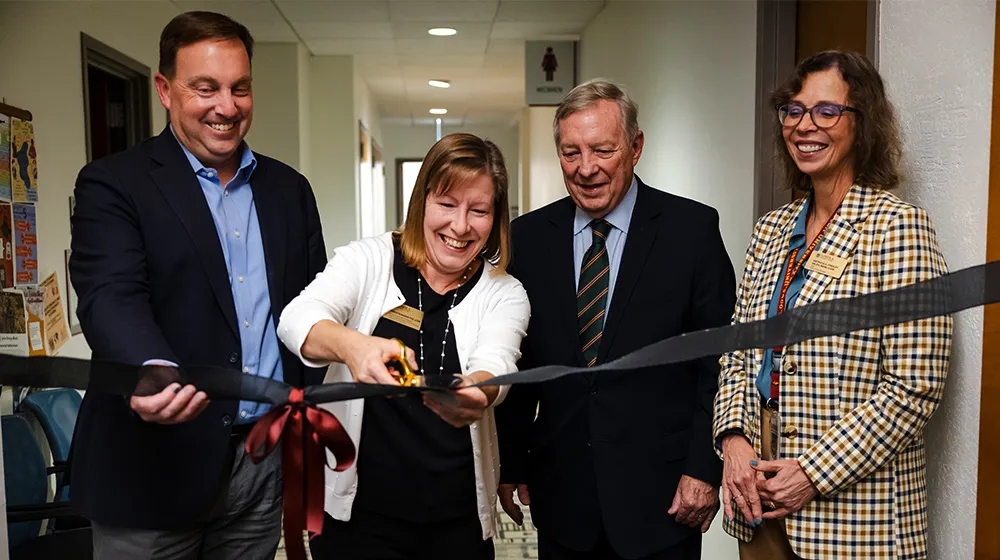
School of Social Work
Loyola students hone professional skills in innovative Behavioral Simulation Lab
💖苹果ID | 15年以上老号 | Icloud后缀 | 激活iCloud设置和下载APP | 美国/香港/中国/台湾/韩国/日本's new simulation lab offers social work students the chance to experience multiple realistic environments while preparing for their professions.
Read more about simulation learning
Marcella Niehoff School of Nursing
At Loyola Nursing, professor investigates a methodology to promote focus
Assistant Professor Ginger Schroers is testing the Stay SAFE methodology for managing interruptions for better patient outcomes.
Learn more about nursingJust 50 miles northwest of Chicago, the ecology campus packs a wide variety of habitats into a compact tract of land. “Within that 100 acres, we’ve got grassland, deciduous forest, pine forest, oak savanna, wetland, a pond, and a creek. There are areas with invasive species as well as areas that students in the Restoration Club have cleared of invasive species. Beyond that, there is an area of LUREC that is farmed, and of course there are landscaped areas too. The diversity of habitats is immense,” said Associate Professor Ray Dybzinski, an ecologist who teaches courses at the site each spring. “Taking a class at LUREC and learning ecology in an ecological setting gives students a deep understanding of how these systems work.”
In addition to providing an ideal site for study, students say the experiential learning aspects of the courses at LUREC improve their ability to absorb and retain knowledge. “We go to different terrains and biomes with drastically different ecological histories, and I think observing those in person helped me connect to the content a lot better,” said environmental science major Brandi Heglar (BS ’26), who took Principles of Ecology with Dybzinski.
A typical day in the ecology course begins in the classroom but quickly migrates to the outdoors where students put their studies to work. “The great benefit of having a class at LUREC is that we can spend an hour with the usual PowerPoint slides indoors, but then we can walk right outside and touch and see and feel and think about all of the concepts that we're learning in the diverse ecosystems of LUREC,” said Dybzinski. Some of the students in his class will go on to become ecologists, while most will work in other fields connected to sustainability, but Dybzinski said the course will provide them all with essential knowledge. “As they become informed citizens and professionals out in the world, making a difference for our planet and our people, they’ll need to understand how natural systems actually work, and I think having this hands-on experience at LUREC sets them up for that and introduces students to the principles that govern life on earth.”
The great benefit of having a class at LUREC is that we can spend an hour with the usual PowerPoint slides indoors, but then we can walk right outside and touch and see and feel and think about all of the concepts that we're learning. Associate Professor Ray Dybzinski
In Dybzinski’s junior-level agroecosystems course, students visit nearby farms in northern Illinois, a rich agricultural center, and perform experiments to assess the ecological health of topsoils. “A lot of people say that if you're doing farming in a forward-thinking, regenerative way, you're really farming the soil. If the soil is healthy, the plants can take care of themselves. Industrial agriculture tends to deplete and kill soil, treating it merely as a substrate into which the farmer dumps chemicals.” Students took soil samples directly from a variety of farms, some small and dedicated to sustainable farming and others employing more common large-scale industrial farming methods. With the help of microbiologist Gregory Palmer, an advanced lecturer at SES, students cultured the soil samples on agar plates and assessed the number and diversity of organisms in each sample in LUREC’s well-appointed laboratory to determine the health of the samples. “It's a bit of a black box, but broadly speaking, a greater diversity of soil organisms correlates with greater soil health, and there’s a correlation between the practices of those farms and how diverse and abundant those microbes are.”
Many students say visiting the ecology campus is one of the highlights of their time at Loyola because of the immersive nature of the experience. “We really get to dive into the course content, and we also structure the classes so that the students have time to actually enjoy the fact that they're in this natural setting,” said Dybzinski. “They’re all living together and sharing meals, and it creates a real camaraderie.”
Last May, Assistant Professor Brian Ohsowski introduced a LUREC course that allowed students to earn professional certifications. He led students through the process of earning the Illinois Boating Safety Certificate, FAA Remote Pilot Certificate, NOLS Wilderness First Aid Certificate, and Midwest Ecological Prescription Burn Crew Member Training. In these sessions, students learned practical skills for field researchers, such as how to tie knots, assess forest volume, and navigate with a compass.
Anna Leigh Tangeman (BS, BA ’26) said she valued the opportunity to build practical career skills. “This class has given me the biggest boost in terms of looking for work later. I have so many certifications that employers are looking for,” she said. “I have the thing to put on my resume, but I also really know how to use it.”
Just 50 miles northwest of Chicago, the ecology campus packs a wide variety of habitats into a compact tract of land. “Within that 100 acres, we’ve got grassland, deciduous forest, pine forest, oak savanna, wetland, a pond, and a creek. There are areas with invasive species as well as areas that students in the Restoration Club have cleared of invasive species. Beyond that, there is an area of LUREC that is farmed, and of course there are landscaped areas too. The diversity of habitats is immense,” said Associate Professor Ray Dybzinski, an ecologist who teaches courses at the site each spring. “Taking a class at LUREC and learning ecology in an ecological setting gives students a deep understanding of how these systems work.”
In addition to providing an ideal site for study, students say the experiential learning aspects of the courses at LUREC improve their ability to absorb and retain knowledge. “We go to different terrains and biomes with drastically different ecological histories, and I think observing those in person helped me connect to the content a lot better,” said environmental science major Brandi Heglar (BS ’26), who took Principles of Ecology with Dybzinski.
A typical day in the ecology course begins in the classroom but quickly migrates to the outdoors where students put their studies to work. “The great benefit of having a class at LUREC is that we can spend an hour with the usual PowerPoint slides indoors, but then we can walk right outside and touch and see and feel and think about all of the concepts that we're learning in the diverse ecosystems of LUREC,” said Dybzinski. Some of the students in his class will go on to become ecologists, while most will work in other fields connected to sustainability, but Dybzinski said the course will provide them all with essential knowledge. “As they become informed citizens and professionals out in the world, making a difference for our planet and our people, they’ll need to understand how natural systems actually work, and I think having this hands-on experience at LUREC sets them up for that and introduces students to the principles that govern life on earth.”
In Dybzinski’s junior-level agroecosystems course, students visit nearby farms in northern Illinois, a rich agricultural center, and perform experiments to assess the ecological health of topsoils. “A lot of people say that if you're doing farming in a forward-thinking, regenerative way, you're really farming the soil. If the soil is healthy, the plants can take care of themselves. Industrial agriculture tends to deplete and kill soil, treating it merely as a substrate into which the farmer dumps chemicals.” Students took soil samples directly from a variety of farms, some small and dedicated to sustainable farming and others employing more common large-scale industrial farming methods. With the help of microbiologist Gregory Palmer, an advanced lecturer at SES, students cultured the soil samples on agar plates and assessed the number and diversity of organisms in each sample in LUREC’s well-appointed laboratory to determine the health of the samples. “It's a bit of a black box, but broadly speaking, a greater diversity of soil organisms correlates with greater soil health, and there’s a correlation between the practices of those farms and how diverse and abundant those microbes are.”
Many students say visiting the ecology campus is one of the highlights of their time at Loyola because of the immersive nature of the experience. “We really get to dive into the course content, and we also structure the classes so that the students have time to actually enjoy the fact that they're in this natural setting,” said Dybzinski. “They’re all living together and sharing meals, and it creates a real camaraderie.”
Last May, Assistant Professor Brian Ohsowski introduced a LUREC course that allowed students to earn professional certifications. He led students through the process of earning the Illinois Boating Safety Certificate, FAA Remote Pilot Certificate, NOLS Wilderness First Aid Certificate, and Midwest Ecological Prescription Burn Crew Member Training. In these sessions, students learned practical skills for field researchers, such as how to tie knots, assess forest volume, and navigate with a compass.
Anna Leigh Tangeman (BS, BA ’26) said she valued the opportunity to build practical career skills. “This class has given me the biggest boost in terms of looking for work later. I have so many certifications that employers are looking for,” she said. “I have the thing to put on my resume, but I also really know how to use it.”