
The Future of Philanthropy 2026 recap
How philanthropy is being reshaped by the Great Wealth Transfer
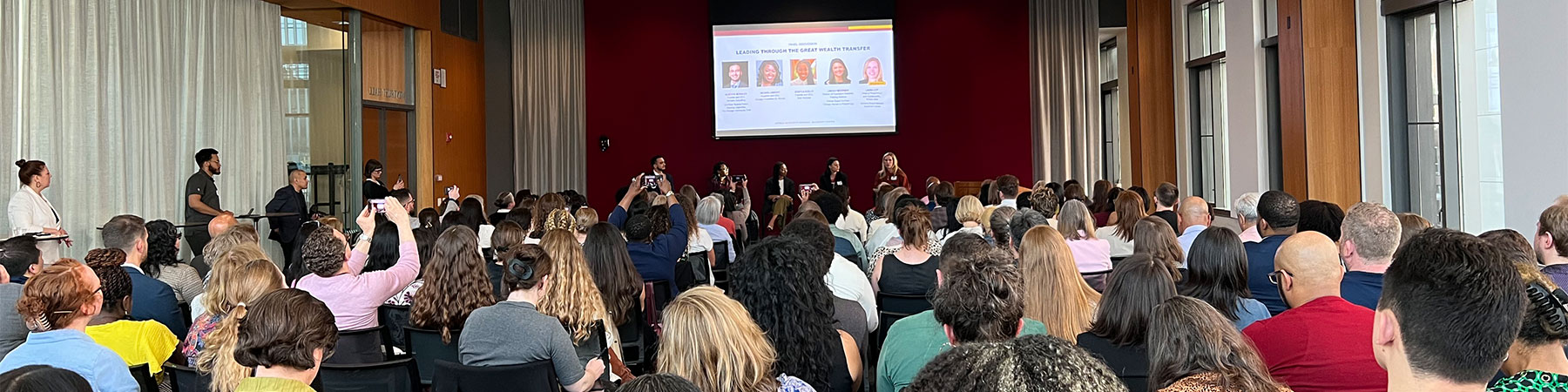
The Baumhart Center for Social Enterprise and Responsibility hosted The Future of Philanthropy: Leading Through the Great Wealth Transfer, bringing together philanthropic leaders, nonprofit professionals, and wealth advisors to explore how a historic shift in wealth and leadership is reshaping the landscape of giving.
Setting the Stage: A Historic Wealth Transfer
The conversation opened with a landscape overview by Darcy Addison (Grant Philanthropic Advisors; Baumhart Scholars MBA ‘22). An estimated $120 trillion in assets is projected to shift primarily to Gen Xers and Millennials by 2045—what many are calling the largest wealth transfer in human history. More than 50% of that wealth is expected to be inherited by women, due in part to longer lifespans and changing family structures.
This is both a financial and leadership transfer: women are transitioning into philanthropic decision-making roles at an unprecedented rate, bringing fundamentally different values and approaches to giving.

Darcy Addison (Grant Philanthropic Advisors; Baumhart Scholars MBA '22)
The 6 T's: Redefining What Giving Looks Like
Addison presented an updated framework for philanthropy with the 6 T's: Time, Talent, Treasure, Testimony, Ties, and Trust.
"All 6 T's are a form of philanthropy."
Laura Coy
Partner, William Blair; Baumhart Advisory Board Member
In practice, this expanded model looks like giving that is more collaborative, long-term, impact-driven, and relational. According to the Women's Philanthropy Institute at Indiana University, giving to women's and girls' organizations surpassed 2% of overall U.S. charitable giving in 2022, reaching 2.18%: a meaningful milestone, even as the field acknowledges there is still a long way to go.
The Future Is Female
Keenya Lambert (Chicago Foundation for Women) offered a powerful perspective on what women's growing control of capital means for who holds decision-making power and how impact is defined.
When the Chicago Foundation for Women was founded, most Chicago foundations were led by men, and many doubted these women could succeed. Today, the Foundation is working to democratize giving through six giving circles and recently awarded $100,000 to organizations with budgets under $800,000.
"Women will lead the movement to create wealth for other women."
Keenya Lambert
President and CEO, Chicago Foundation for Women
Lambert emphasized that pay equity, comprehensive benefits, and creating workspaces that support women's economic advancement are all part of the philanthropic picture, contributing to success for women and girls as both wealth builders and decision makers.
Reimagining Wealth and Repair
Jessyca Dudley (Bold Ventures) brought a distinctive perspective to the room. Her team at Bold Ventures works with inheritors whose source of wealth doesn't always align with their values and who want to use that wealth for repair.
For example, women within family businesses are recognizing the harmful environmental or social impact of those businesses, and are seeking to rectify the harm caused. Women within family enterprises are also beginning to question their assumed roles in running the philanthropic arm, while male heirs run the business.
"Understanding how the money was made can lead to repair."
Jessyca Dudley
Founder and CEO, Bold Ventures
Dudley noted that women tend to ask collaborative questions when deploying capital such as, “who should I know?” and “how do I do this giving collaboratively?” They are also interested in ensuring that their investments don't undermine the grantmaking they are doing, and are exploring how to move capital out of the market in order to give more.

Pictured (left to right): Alberto Morales (Morales Consulting), Keenya Lambert (Chicago Foundation for Women), Jessyca Dudley (Bold Ventures), Lindsey Moorman (Feeding America), Laura Coy (William Blair)
The Wealth Gap and the Speed of Trust
Lindsey Moorman (Feeding America) raised an urgent counterpoint to the wealth transfer conversation: as wealth amasses at the top, the wealth gap also widens, and the need for fast, flexible capital has never been greater.
Moorman noted that many people are accessing food assistance not at a single moment of crisis, but in a sustained way, often while working multiple jobs. Addressing that reality requires working at a systems level, not just responding to individual needs.
She also highlighted the important role of trust-based philanthropy in deploying capital quickly, pointing to the recent government shutdown as an example of a moment when nonprofit partners needed resources fast. At the same time, she acknowledged the tension organizations face: they are accountable to the individuals they serve and it can be difficult to balance that with donor intent. More partnership models, she noted, are starting to listen to what nonprofits are saying on the ground.
"Embedding equity into your practices means bringing communities to the table to shape solutions. We are accountable to the people we serve."
Lindsey Moorman
Director of Foundation Relations, Feeding America
Inclusion and Power
Alberto Morales (Morales Consulting) anchored the conversation in questions of who is truly at the table and what it means to be there.
There are stark differences between today and ten years ago in terms of the diversity of who participates in philanthropic spaces. Morales noted that there are now 150 philanthropic CEOs, executive directors, and program officers in Chicago Latines in Philanthropy, with two-thirds of them being women.
With this progress, Morales also named a persistent barrier holding institutions back: institutional giving often remains stuck at the governance level when it comes to inclusion. Bylaws restrict who receives a seat at the table and how capital can be deployed. Boards need to consider how they are sharing seats with the communities they serve, and how they can direct resources more effectively.
"Consultation does not equate to inclusion. Inclusion and power-sharing must go hand in hand."
Alberto Morales
Founder and CEO, Morales Consulting
Key Takeaways
- The largest wealth transfer in human history is also a values transfer. As women gain control of capital, they are reshaping who decides, who benefits, and what counts as impact.
- Philanthropy is fluid, not rigid. The 6 T's remind us that giving takes many forms and that everyone has something to offer.
- Speed and trust are inseparable. The communities closest to the challenges need capital fast and they need funders who trust them to deploy it well.
- Inclusion must reach governance. Consultation is not enough. Real power-sharing means communities shaping strategy, funding, and governance.
- The relational nature of philanthropy remains despite the shifts in giving. The most effective giving is built on long-term relationships, strategic empathy, and proximity to the work.
Upcoming Events
- Chicago Foundation for Women – Giving Circles & Councils Event (May 20th)
On May 20th, all six of CFW's Giving Circles and Councils will come together at the Public Housing Museum for a special event featuring two authors from The Uprising of Women in Philanthropy, including panelist Jessyca Dudley. The event reflects many themes explored during The Future of Philanthropy conversation and is open to the public. Register here.
Get Involved
- Support the Work of Feeding America
The work of addressing food insecurity happens at the national and local level. To learn more about Feeding America's efforts, visit feedingamerica.org. Ready to act? Find ways to support neighbors in your own community. - Connect with Chicago Women in Philanthropy
Chicago Women in Philanthropy (CWIP) is a community of philanthropic, corporate-giving, and nonprofit women and non-binary individuals committed to helping women and girls advance in society. CWIP fosters connection, shared learning, and cross-sector collaboration to strengthen gender-focused philanthropy in the Chicago region. Through events, dialogue, and leadership opportunities, members build relationships and deepen their impact. Visit their website to learn more, explore upcoming events, or find out how to become a member.
Resources for Continued Learning
- Equity & Inclusion in Chicago Philanthropy
Explore the Nuestro Futuro initiative and its commissioned landscape scan, Assessing Philanthropic Support for Latines in the Chicago Area, led by the UIC Great Cities Institute, which found that only 1.9% of foundation dollars in Cook County go to Latine communities. Learn more and access the report by visiting www.cct.org/nuestro-futuro. - Philanthropy Insights from William Blair
William Blair offers resources for donors, advisors, and families seeking to align values with long-term impact:
These tools support more intentional, strategic approaches to charitable giving.
- Repair & Reparative Philanthropy Resources
To explore themes raised by Jessyca Dudley around repair, inherited wealth, and values-aligned capital deployment, visit Reparative Philanthropy at reparativephilanthropy.co for frameworks and learning resources on reparative giving practices. - Upcoming Article on the Great Wealth Transfer
Building on themes from The Future of Philanthropy, landscape overview speaker and Baumhart Scholar ’22 Darcy Addison will be featured in an upcoming Boston Globe article by journalist Elizabeth Svoboda. The piece, tentatively titled, "The Future of Philanthropy is Female," explores how the Great Wealth Transfer is placing unprecedented wealth in the hands of women, reshaping philanthropic leadership and values-driven giving. The article also features Chicago-connected leaders Regan Pritzker of the Kataly Foundation and Angelique Power of the Skillman Foundation.
The Baumhart Center for Social Enterprise and Responsibility hosted The Future of Philanthropy: Leading Through the Great Wealth Transfer, bringing together philanthropic leaders, nonprofit professionals, and wealth advisors to explore how a historic shift in wealth and leadership is reshaping the landscape of giving.
"The purpose of philanthropy is to make change in this world.”
Darcy Addison
Grant Philanthropic Advisors; Baumhart Scholars MBA ‘22
Setting the Stage: A Historic Wealth Transfer
The conversation opened with a landscape overview by Darcy Addison (Grant Philanthropic Advisors; Baumhart Scholars MBA ‘22). An estimated $120 trillion in assets is projected to shift primarily to Gen Xers and Millennials by 2045—what many are calling the largest wealth transfer in human history. More than 50% of that wealth is expected to be inherited by women, due in part to longer lifespans and changing family structures.
This is both a financial and leadership transfer: women are transitioning into philanthropic decision-making roles at an unprecedented rate, bringing fundamentally different values and approaches to giving.
The 6 T's: Redefining What Giving Looks Like
Addison presented an updated framework for philanthropy with the 6 T's: Time, Talent, Treasure, Testimony, Ties, and Trust.
"All 6 T's are a form of philanthropy."
Laura Coy
Partner, William Blair; Baumhart Advisory Board Member
In practice, this expanded model looks like giving that is more collaborative, long-term, impact-driven, and relational. According to the Women's Philanthropy Institute at Indiana University, giving to women's and girls' organizations surpassed 2% of overall U.S. charitable giving in 2022, reaching 2.18%: a meaningful milestone, even as the field acknowledges there is still a long way to go.
The Future Is Female
Keenya Lambert (Chicago Foundation for Women) offered a powerful perspective on what women's growing control of capital means for who holds decision-making power and how impact is defined.
When the Chicago Foundation for Women was founded, most Chicago foundations were led by men, and many doubted these women could succeed. Today, the Foundation is working to democratize giving through six giving circles and recently awarded $100,000 to organizations with budgets under $800,000.
"Women will lead the movement to create wealth for other women."
Keenya Lambert
President and CEO, Chicago Foundation for Women
Lambert emphasized that pay equity, comprehensive benefits, and creating workspaces that support women's economic advancement are all part of the philanthropic picture, contributing to success for women and girls as both wealth builders and decision makers.
Reimagining Wealth and Repair
Jessyca Dudley (Bold Ventures) brought a distinctive perspective to the room. Her team at Bold Ventures works with inheritors whose source of wealth doesn't always align with their values and who want to use that wealth for repair.
For example, women within family businesses are recognizing the harmful environmental or social impact of those businesses, and are seeking to rectify the harm caused. Women within family enterprises are also beginning to question their assumed roles in running the philanthropic arm, while male heirs run the business.
"Understanding how the money was made can lead to repair."
Jessyca Dudley
Founder and CEO, Bold Ventures
Dudley noted that women tend to ask collaborative questions when deploying capital such as, “who should I know?” and “how do I do this giving collaboratively?” They are also interested in ensuring that their investments don't undermine the grantmaking they are doing, and are exploring how to move capital out of the market in order to give more.
The Wealth Gap and the Speed of Trust
Lindsey Moorman (Feeding America) raised an urgent counterpoint to the wealth transfer conversation: as wealth amasses at the top, the wealth gap also widens, and the need for fast, flexible capital has never been greater.
Moorman noted that many people are accessing food assistance not at a single moment of crisis, but in a sustained way, often while working multiple jobs. Addressing that reality requires working at a systems level, not just responding to individual needs.
She also highlighted the important role of trust-based philanthropy in deploying capital quickly, pointing to the recent government shutdown as an example of a moment when nonprofit partners needed resources fast. At the same time, she acknowledged the tension organizations face: they are accountable to the individuals they serve and it can be difficult to balance that with donor intent. More partnership models, she noted, are starting to listen to what nonprofits are saying on the ground.
"Embedding equity into your practices means bringing communities to the table to shape solutions. We are accountable to the people we serve."
Lindsey Moorman
Director of Foundation Relations, Feeding America
Inclusion and Power
Alberto Morales (Morales Consulting) anchored the conversation in questions of who is truly at the table and what it means to be there.
There are stark differences between today and ten years ago in terms of the diversity of who participates in philanthropic spaces. Morales noted that there are now 150 philanthropic CEOs, executive directors, and program officers in Chicago Latines in Philanthropy, with two-thirds of them being women.
With this progress, Morales also named a persistent barrier holding institutions back: institutional giving often remains stuck at the governance level when it comes to inclusion. Bylaws restrict who receives a seat at the table and how capital can be deployed. Boards need to consider how they are sharing seats with the communities they serve, and how they can direct resources more effectively.
"Consultation does not equate to inclusion. Inclusion and power-sharing must go hand in hand."
Alberto Morales
Founder and CEO, Morales Consulting
Key Takeaways
- The largest wealth transfer in human history is also a values transfer. As women gain control of capital, they are reshaping who decides, who benefits, and what counts as impact.
- Philanthropy is fluid, not rigid. The 6 T's remind us that giving takes many forms and that everyone has something to offer.
- Speed and trust are inseparable. The communities closest to the challenges need capital fast and they need funders who trust them to deploy it well.
- Inclusion must reach governance. Consultation is not enough. Real power-sharing means communities shaping strategy, funding, and governance.
- The relational nature of philanthropy remains despite the shifts in giving. The most effective giving is built on long-term relationships, strategic empathy, and proximity to the work.
Upcoming Events
- Chicago Foundation for Women – Giving Circles & Councils Event (May 20th)
On May 20th, all six of CFW's Giving Circles and Councils will come together at the Public Housing Museum for a special event featuring two authors from The Uprising of Women in Philanthropy, including panelist Jessyca Dudley. The event reflects many themes explored during The Future of Philanthropy conversation and is open to the public. Register here.
Get Involved
- Support the Work of Feeding America
The work of addressing food insecurity happens at the national and local level. To learn more about Feeding America's efforts, visit feedingamerica.org. Ready to act? Find ways to support neighbors in your own community. - Connect with Chicago Women in Philanthropy
Chicago Women in Philanthropy (CWIP) is a community of philanthropic, corporate-giving, and nonprofit women and non-binary individuals committed to helping women and girls advance in society. CWIP fosters connection, shared learning, and cross-sector collaboration to strengthen gender-focused philanthropy in the Chicago region. Through events, dialogue, and leadership opportunities, members build relationships and deepen their impact. Visit their website to learn more, explore upcoming events, or find out how to become a member.
Resources for Continued Learning
- Equity & Inclusion in Chicago Philanthropy
Explore the Nuestro Futuro initiative and its commissioned landscape scan, Assessing Philanthropic Support for Latines in the Chicago Area, led by the UIC Great Cities Institute, which found that only 1.9% of foundation dollars in Cook County go to Latine communities. Learn more and access the report by visiting www.cct.org/nuestro-futuro. - Philanthropy Insights from William Blair
William Blair offers resources for donors, advisors, and families seeking to align values with long-term impact:
These tools support more intentional, strategic approaches to charitable giving.
- Repair & Reparative Philanthropy Resources
To explore themes raised by Jessyca Dudley around repair, inherited wealth, and values-aligned capital deployment, visit Reparative Philanthropy at reparativephilanthropy.co for frameworks and learning resources on reparative giving practices. - Upcoming Article on the Great Wealth Transfer
Building on themes from The Future of Philanthropy, landscape overview speaker and Baumhart Scholar ’22 Darcy Addison will be featured in an upcoming Boston Globe article by journalist Elizabeth Svoboda. The piece, tentatively titled, "The Future of Philanthropy is Female," explores how the Great Wealth Transfer is placing unprecedented wealth in the hands of women, reshaping philanthropic leadership and values-driven giving. The article also features Chicago-connected leaders Regan Pritzker of the Kataly Foundation and Angelique Power of the Skillman Foundation.